EMUTM (Ecosystem Management Understanding) is a land management program for pastoralists that introduces land users to the ecological management of landscapes and habitats by learning to recognise and read landscape processes, condition and trend, and to capture rainwater onsite.
EMU is about recovering natural processes of drainage, habitat patterns and the working nuts and bolts of the living land. EMU provides ecological best-fit recovery and maintenance solutions particular to place and trend.
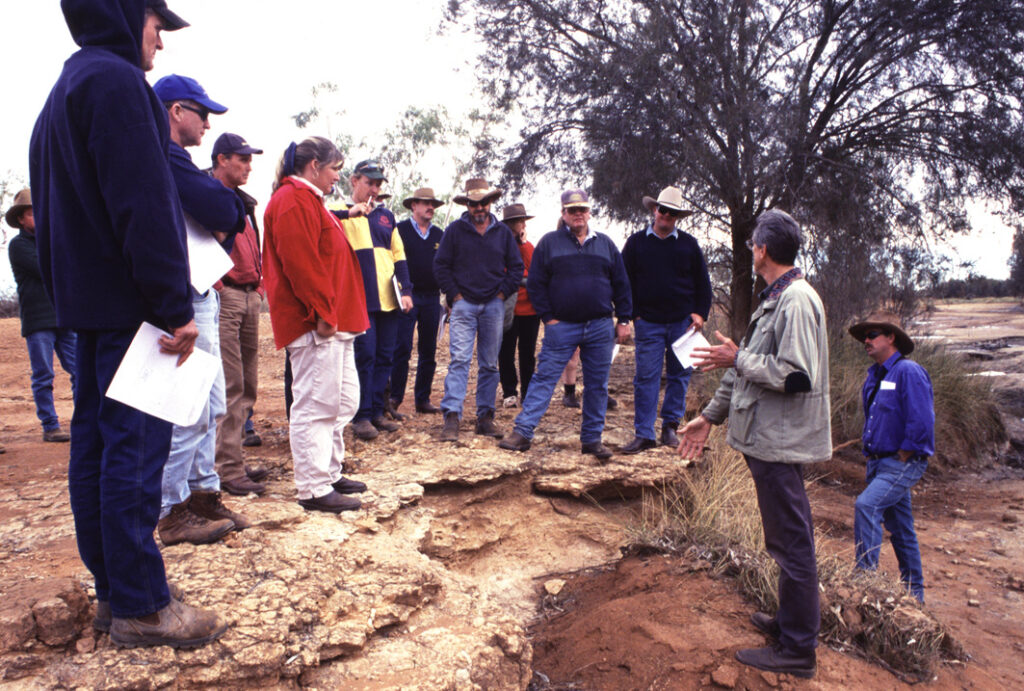
Land productivity is fundamentally based on keeping rainwater in the soil and land management is optimally based on drainage units. The EMU program brings together communities who share the same catchment areas. Participants initially record their knowledge of their own land in an overlay mapping exercise. This is followed by an aerial overview and then ground traverses of the key areas and issues identified by the mapping process. During the workshops knowledge is shared between participants and their facilitators with resultant reciprocal learning.
A goal of EMU is to build socio-ecological resilience in land users through the use of their knowledge of their land, their capacity to adapt, and their willingness to work with the natural processes towards recovery of habitats and biodiversity.
The program’s ultimate success occurs when pastoralists/managers rarely require extension help and instead help guide other managers in mapping their knowledge and learning how to recognise and interpret the signs of their land for recovery and maintenance purposes towards attaining a viable Triple Bottom Line.
EMU is about wetland reclamation, recovery of habitat diversity and function, climate change adaptation, sacred site planning, landscape-smart grazing strategies, and landscape-scale permaculture.
Wildlife conservation is the practice of protecting wild animal and plant species and their habitats. The primary goal of wildlife conservation is to ensure the long-term survival of these species, maintain biodiversity, and preserve the delicate balance of ecosystems.
EMU workshops are held on pastoral stations/ranches or rural land-use areas where participants attend voluntarily and are led by trained EMU facilitators.
Currently groups of graziers, tribal communities, game farmers and wildlife managers in Australia, Namibia, Ethiopia and Tajikistan have participated in workshops using the EMU approach.